Odoo Point of Sale: Sell faster, with tax compliance and inventory in real time
Complete POS: NFC-e, TEF, and offline operation, all integrated with Odoo
Odoo POS turns any tablet, laptop, or terminal into an agile point of sale, with native NFC-e issuance, TEF integration, full offline operation, and automatic synchronization with inventory, finance, and CRM. For Brazilian retail and food service, it is the only solution that combines tax compliance, queue management, and loyalty in a single open source platform.
Sales Official Odoo module
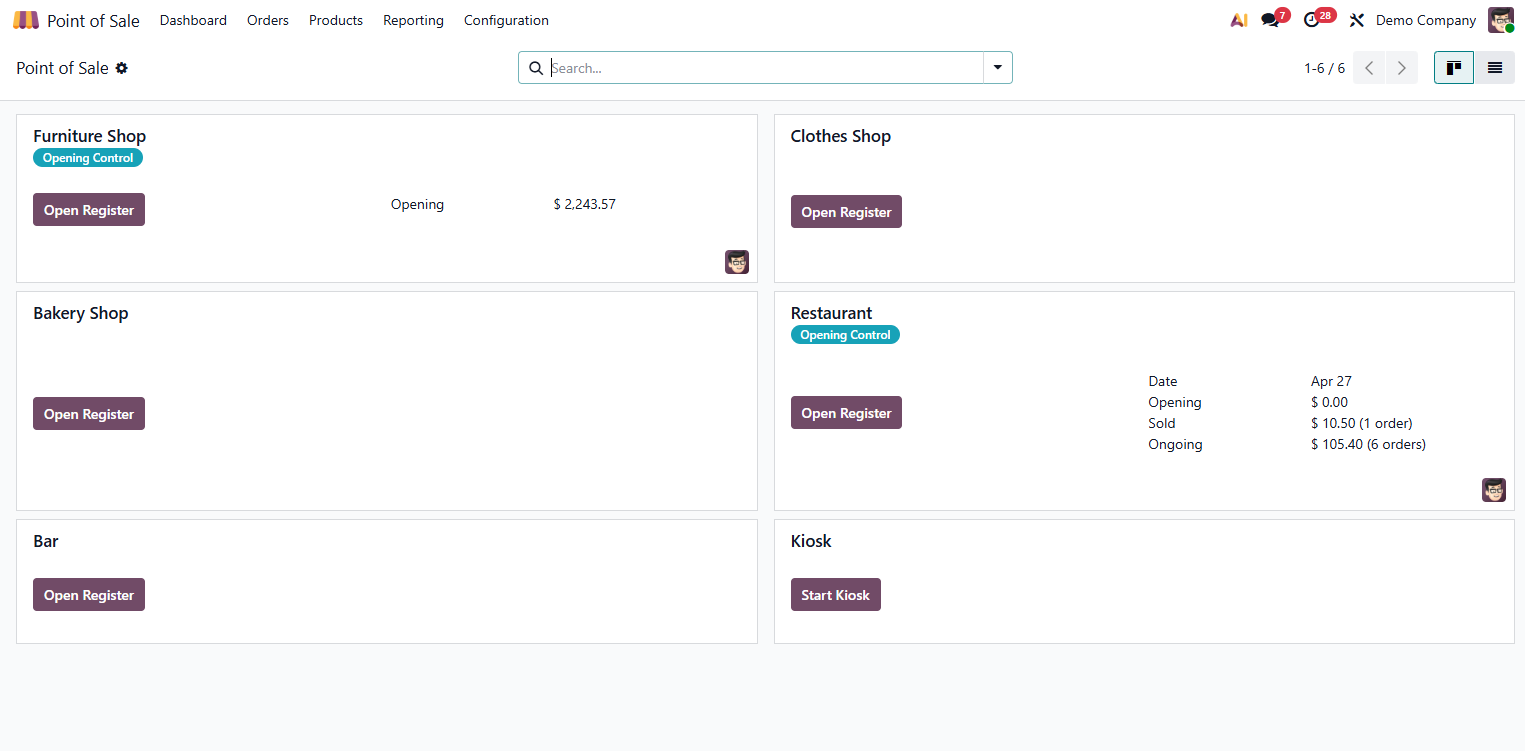
Why Odoo Point of Sale?
Real results our clients achieve.
Checkout in under 30 seconds
A touch-optimized interface, barcode scanning, and contactless payment reduce average service time by up to 60%, eliminating lines and increasing cash register turnover.
Offline operation without interruptions
The POS keeps working during internet outages: sales, payments, and tax document issuance are stored locally and automatically synchronized once the connection returns.
100% integrated tax compliance: NFC-e in every state
Automatic issuance of NFC-e (SEFAZ), including in São Paulo, directly from the POS, with no external software. Cancellation, voiding, and offline contingency managed on the same operator screen.
Unified inventory and finance
Every sale updates inventory, accounts receivable, and the income statement in real time, with no manual entries. Multiple stores with distinct cost centers and transfers between warehouses, all in the same ERP.
Features
What's included in this module.
NFC-e Issuance (Electronic Consumer Invoice)
Real-time authorization with the state SEFAZ, NFC-e DANFE for 80mm thermal printers, and QR Code for the consumer. Support for offline contingency with later batch transmission. Compatible with all Brazilian states.
End of SAT-CF-e (SP) and MF-e (CE): everything on NFC-e
In São Paulo, CF-e-SAT issuance has been prohibited since 01/01/2026 (Portaria SRE 79/2024), and in Ceará the MF-e stopped being accepted on the same date (Decreto 36.417/2025). In these states Odoo POS operates with NFC-e, using the same configuration as in the other states, with no dedicated fiscal device.
TEF Integration (Electronic Funds Transfer)
Support for dedicated and dial-up TEF (Cielo, Rede, Stone, GetNet, PagSeguro) via the SiTef/CliSiTef protocol. Automatic payment confirmation at the POS with no double entry, automatic bank reconciliation in Finance.
Offline operation and automatic synchronization
With a local session in IndexedDB, the register works for hours without connectivity. Upon reconnecting, orders, payments, and tax documents are synchronized incrementally and without conflicts.
Table and order management (restaurant)
Configurable digital floor plan: creation and mapping of tables by dining room, transfer of items between tabs, bill splitting by item or percentage, and occupancy time control with visual alerts.
KDS: Kitchen Display System
A kitchen production screen displays orders by preparation category (cold dishes, grilled items, drinks) with a timer and status. Eliminates paper tickets, reduces errors, and integrates with the Manufacturing module for recipes.
Loyalty programs and coupons
Points per purchase, cashback, gift cards, and discount coupons with expiration and restrictions by product or category. Integrated with the Odoo Marketing module for campaigns segmented by purchase history.
Multi-store and multi-company
Independent settings per store (tax series, printer, payment methods), consolidated reports across the chain, and stock transfers between branches. User permissions ensure data isolation between stores.
Session management and cash closing
Opening with a starting cash float, cash withdrawals, cash top-ups, and closing with a variance report by payment method. Full audit trail of every transaction, tracking operator, time, and terminal.
Product catalog with variants and combos
Products with a size/color grid, price per unit of measure, image in the POS, and combo composition (dish + drink + dessert at a single price). Automatic synchronization with the Odoo e-commerce catalog.
Real-time reports and dashboards
Sales per hour, average ticket, best-selling products, performance by salesperson, and comparison between stores. Export to Excel and native integration with the Accounting module.
Self-checkout and kiosk
Kiosk mode for self-service: the customer browses the menu, builds the order, and pays by card or Pix. Reduces the need for operators during peak traffic and improves the experience in fast food and convenience retail.
Native integrations
Odoo Point of Sale connects natively with other Odoo modules, no external integration.
Why implement with KMEE
KMEE implements Odoo POS with the complete Brazilian tax stack (NFC-e with offline contingency, and TEF), serving everything from retail chains with dozens of branches to restaurants and high-volume food service operations. Our team is an active contributor to the OCA/pos and OCA/l10n-brazil repositories, which means our clients benefit from fixes and new features before they reach the official release. We carry out the implementation in phases: tax mapping by CNAE and state, A1/A3 digital certificate setup, operator training, and go-live support.
About KMEEWho it's for
Scenarios where this module delivers the most value.
Retail: Physical stores and franchise chains
Fashion, footwear, pharmacy, and supermarket chains with multiple POS terminals per store and multiple branches. Centralized catalog, pricing and promotions, autonomous NFC-e per point of sale, and real-time stock synchronization.
Restaurant and bar: Table, tab, and delivery
À la carte restaurants, bars, and bistros with table management, tab transfers, bill splitting, and integration with delivery platforms. The KDS eliminates paper in the kitchen, and the register issues NFC-e when closing the bill.
Food Service: Snack bars, fast food, and kiosks
High-volume operations where checkout speed is critical. Self-checkout with QR Code and Pix via TEF, integrated digital menu, and NFC-e in contingency mode to operate in malls with unstable networks.
Omnichannel: E-commerce and physical store integrated
Unified inventory, shared loyalty program, in-store returns of online purchases, and gift cards valid across any channel. The customer buys online and picks up in-store with a 360-degree history.
Frequently Asked Questions
Does Odoo POS issue NFC-e in all Brazilian states?
Yes. NFC-e is a national standard accepted by every state SEFAZ. The l10n_br_pos_nfce module supports all states with offline contingency (tpEmis 9) when the state SEFAZ is unavailable. The series numbering is configured per company/store, and the NFC-e DANFE is printed on 80mm thermal paper or emailed to the consumer when the CPF is provided.
Is SAT-CF-e still required in São Paulo?
No. In São Paulo, CF-e-SAT issuance has been prohibited since 01/01/2026 (Portaria SRE 79/2024), and Ceará's MF-e was also discontinued on the same date. Today NFC-e (model 65), transmitted over the internet to the SEFAZ, is the electronic tax document for in-person sales to end consumers accepted in every state, and it is what Odoo issues at the POS.
How does the TEF integration work? Which acquirers are supported?
TEF integration is done via the SiTef (Software Express) protocol. Supported acquirers include Cielo, Rede, Stone, GetNet, Safra, and PagSeguro. Installments, debit, credit, meal/food vouchers, and Pix via TEF are supported according to each acquirer's enablement.
Does the POS work without internet? What about the tax documents?
Yes. Odoo POS stores the entire session locally in the browser (IndexedDB). For NFC-e, offline contingency mode (tpEmis 9) is activated automatically, transmitting the invoices once the connection returns, within the required deadline (as a rule, 24 hours from issuance). The NFC-e DANFE is printed indicating issuance in contingency.
Is it possible to manage multiple stores with independent POS terminals in a single Odoo instance?
Yes. Each store has its own tax series, digital certificate, printer, and payment method configuration. Inventory is managed by warehouse (one per store) with tracked transfers between branches. Reports consolidate all stores or filter by individual point of sale.
Industries that use it
Complete solutions for your industry.
Explore all Odoo modules
View full catalogStart with a free assessment
Thirty minutes to understand your operation and tell you what to fix first, in the right order. No commitment.